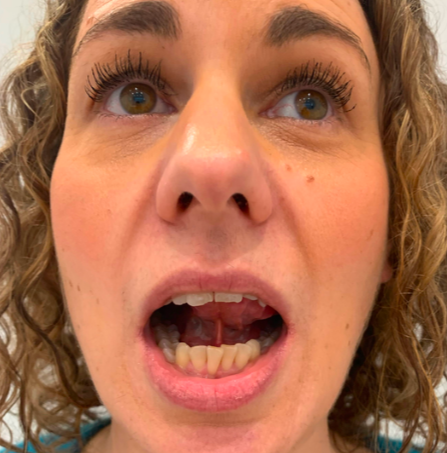


Could a tongue tie be affecting your singing? What singers need to know
Could a tongue tie be affecting your singing?
…What singers need to know
If you’ve ever felt like your voice is harder to use than it should be- a tongue tie could be part of the picture.
Singers I work with often describe:
fatigue or strain
difficulty with high notes or agility
inconsistency that doesn’t improve with practice
a breathy or nasal tone
I’m Gemma Milburn, a UK-based vocal coach working online with singers worldwide. On 1 July 2023, at the age of 38, I discovered I had a tongue tie.
That moment explained years of vocal challenges: throat discomfort, fatigue, hoarseness, difficulty with riffs and runs, uncontrollable breathiness, performance anxiety — and the sense that singing was harder for me than it as for my singing colleagues.
Since then, I’ve completed myofunctional therapy and, in April 2024, a tongue-tie release surgery. For years, I assumed my struggles were down to a lack of talent or not trying hard enough, but this journey has transformed my own singing and the way I help singers facing similar challenges.
Why Tongue Tie Matters for Singers
Tongue tie (ankyloglossia) occurs when the tongue is tethered too tightly, restricting its range of motion. It’s more common than many people think, with some experts estimating around 1 in 4 people are affected. While some say it only impacts articulation, in reality it can influence nearly every part of vocal function:
Breathing patterns
Jaw and body alignment
Resonance and tone quality
Register transitions and vocal stamina
In short: if the tongue can’t move freely, the rest of the vocal system compensates.
5 Ways Tongue Tie Can Affect Singers
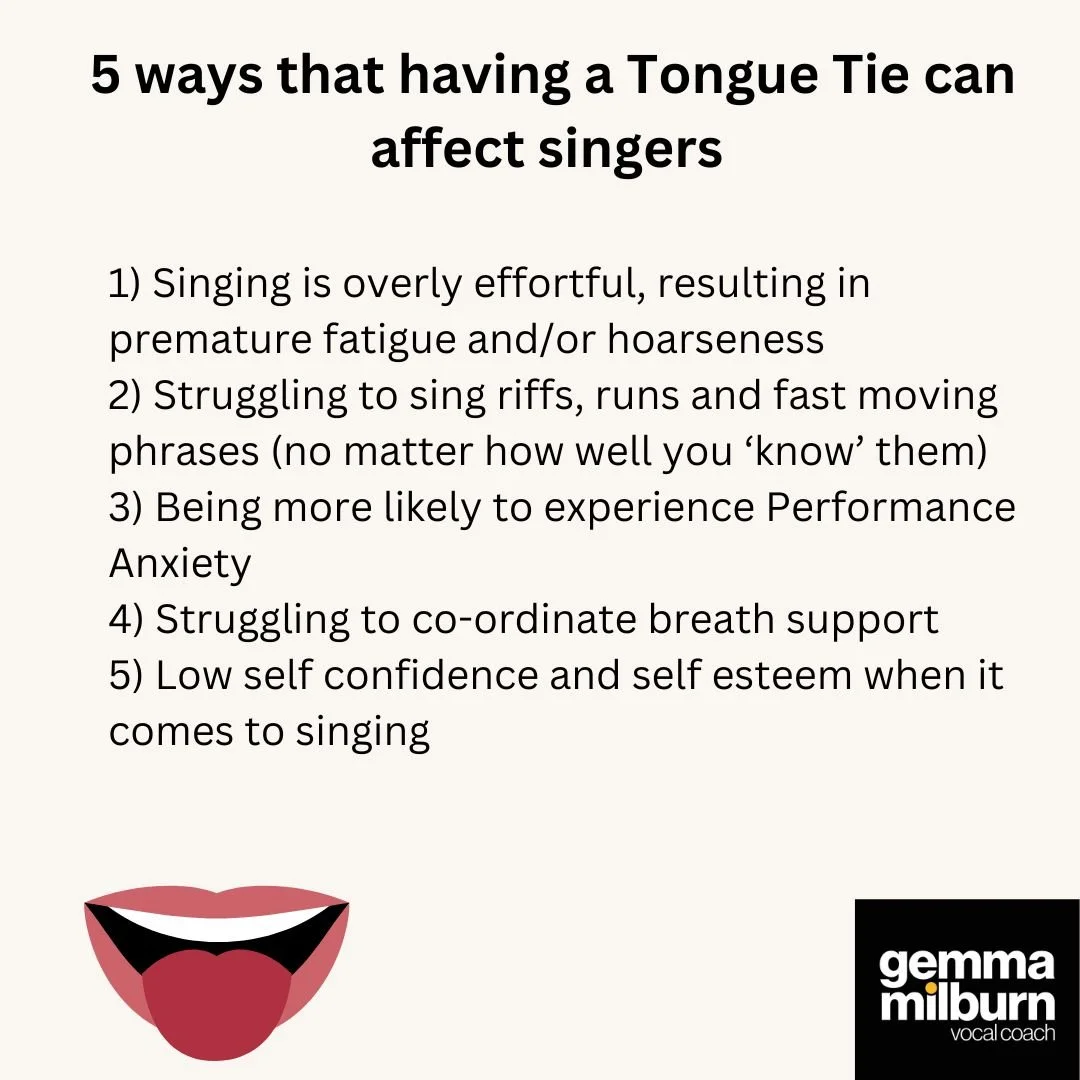
This list often resonates strongly with singers who’ve felt like their technique “should” work, but never quite comes together.
If you’re reading this and recognising yourself, you’re not alone.
Many of the singers I work with have spent years feeling like their voice should be working, but never quite understanding why it doesn’t.
If you’d like to explore what’s going on in your voice, I offer online sessions designed to work with your perfectly unique voice and build something that works for you.
👉 Book a free discovery call to find out more
My Personal Journey
The discovery
After 13 years of being a vocal coach, my own coach noticed something unusual about my tongue. A specialist then confirmed I had a grade 4 (compensating to grade 3) tongue tie — pretty severe, but less visually obvious than the stereotypical “anterior” tie.
Note: You may hear “anterior” or “posterior” used to describe tongue ties. Labels aside, any restrictive tie can be problematic for singers if it limits function.
Therapy first
Because my tongue had never moved freely, it wasn’t strong or coordinated enough to be released safely. I began myofunctional therapy — targeted exercises for the tongue, lips, and jaw. Think of it as physio for your mouth and face.
Surgery
On 26 April 2024, I had my tongue tie released in Ghent, Belgium, by dentist Charlotte Van Bell. She also released an upper lip tie and a buccal tie.
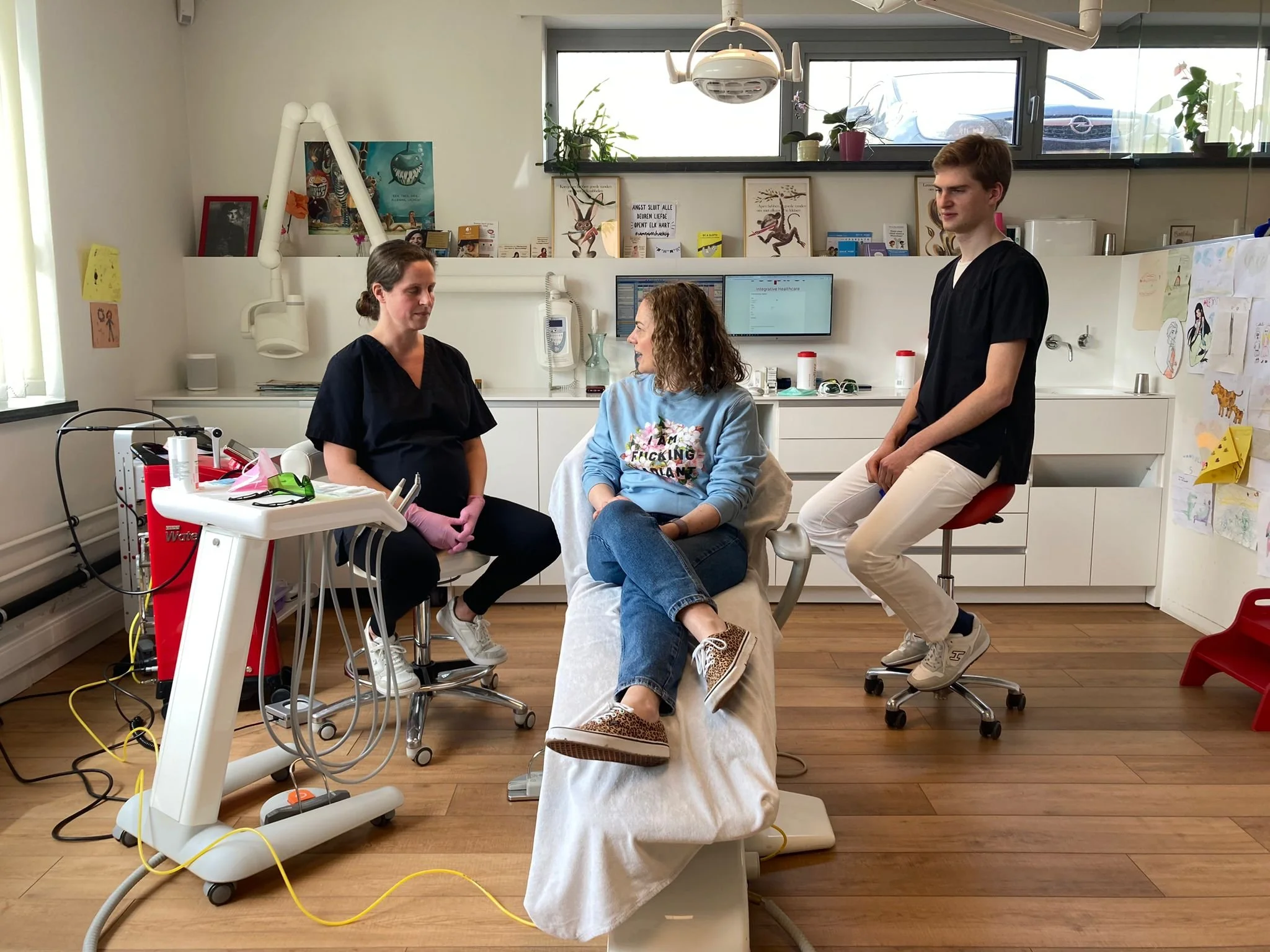
The day of my tongue tie release in Ghent, Belgium - April 2024
Immediate changes
My tongue finally rested on the roof of my mouth.
My lips sealed and my bite felt more comfortable.
Chronic neck and jaw tension eased almost instantly.
I felt calm in a way I rarely had before.
My upper register was immediately easier to access.
Longer-term changes
Easier access to high notes and a more natural vibrato.
Better breath control (supported by my Buteyko training).
Less fatigue and greater flexibility.
A warmer, more adaptable tone.
More resilience at band rehearsals.
Improved concentration and sleep.
Gemma Milburn vocal coach demonstrating myofunctional therapy exercise for tongue tie recovery in singers.
One of the daily Myo exercises I practised before and after release.
Lessons I Now Share With Singers
Since my diagnosis, this has become an important part of how I work with singers. Tongue restriction can influence the whole system the voice relies on — including breathing, cord closure, sound quality and more. I now offer tongue tie aware coaching for singers which you can read about here.
This journey has reinforced something vital: sometimes singing isn’t about trying harder. It’s about recognising when your body is working against you. Many singers say, “It’s all in my head.” Not always. Sometimes our bodies are simply different from the norm, and need a need a different approach. The process also inspired me to qualify as a Buteyko Breathing Instructor, and I blend this work into my vocal coaching. You can learn more about this here.
My Recommendations for Singers
Don’t rely on a diagnosis from a standard practitioner. Many general dentists miss posterior/restrictive ties. Seek a specialist myofunctional therapist or airway-focused dentist.
Commit to therapy. Myofunctional therapy before and after any release retrains strength, coordination and neural patterns.
Know that change is possible. If you’ve lived with vocal fatigue, range limitations or persistent tension, it doesn’t have to stay that way.
No pressure. If you are tongue-tied, don’t panic- treatment is a personal choice. Seek help only if you want to.
I worked with Emily at Breathe First Speech and Myo (Manchester), whose thorough assessment helped me understand how tongue restriction was affecting my singing, posture, sleep, eating and swallowing.

With my myofunctional therapist, Emily at Breathe First Speech and Myo in Manchester. Her assessment and support were key to my recovery and singing progress.
FAQs About Tongue Tie and Singing
Can tongue tie affect my singing voice?
Yes. It can influence breath coordination, resonance, stamina and flexibility — not just articulation.
Do I need surgery if I’m tongue-tied?
Not always. Many singers benefit from myofunctional therapy alone. Surgery may be recommended for more severe restrictions. The choice is always yours.
Is myofunctional therapy necessary?
If you’re pursuing a release, yes — therapy is crucial before and after to build strength and retrain patterns.
How do I know if I’m tongue-tied?
See a specialist myofunctional therapist (e.g., Breathe First Speech and Myo) or an airway-focused dentist for a proper assessment. Signs can include difficulty lifting the tongue when the mouth is open, mouth breathing and chronic vocal fatigue.
Final Thoughts & Next Steps
Discovering my tongue tie and going through treatment has been one of the most transformative experiences of my singing career. It showed me that when singers struggle, the cause isn’t always technique or mindset- sometimes it’s structural.
If you’re reading this and recognising yourself — feeling stuck, inconsistent, or like your voice isn’t responding the way it should — this is exactly the kind of work I help singers with in tongue tie aware vocal coaching. I offer online sessions designed to understand what’s happening in your voice and build a plan that works for you long-term.
👉 Book a free discovery call to find out more.